
About Us
Eprofess Group is a results-driven digital marketing agency helping businesses build a stronger online presence and achieve sustainable growth. We combine creative design, strategic marketing, website development, SEO, and social media solutions to help brands connect with the right audience and grow in the digital space.
Social Links
AEO, GEO vs SEO: What Businesses Need to Know in 2026
Search is changing faster than ever.
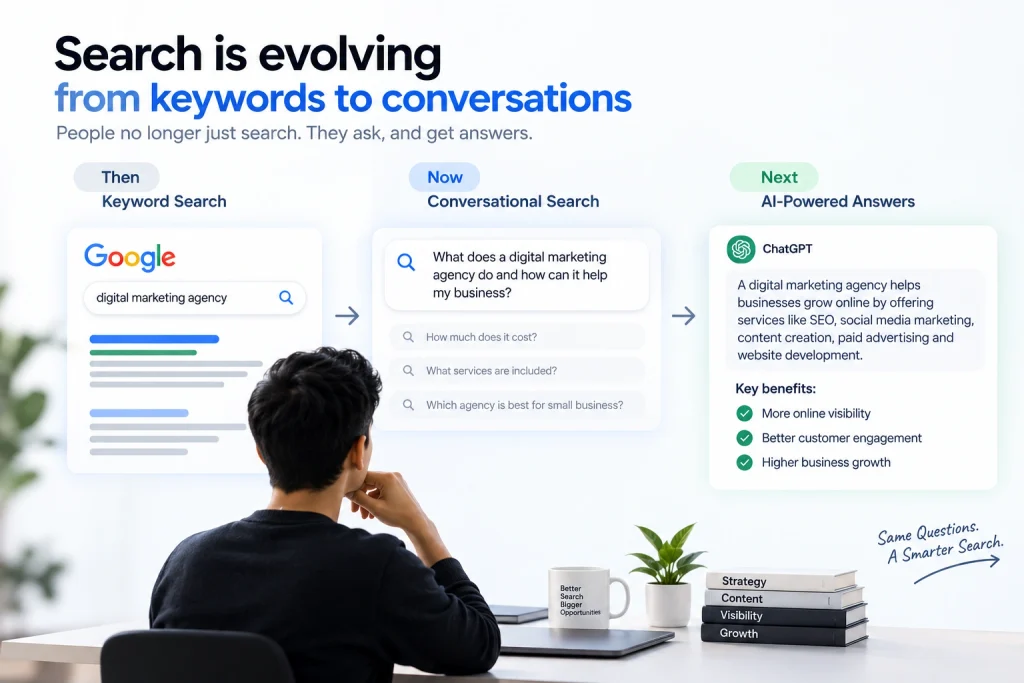
For years, businesses focused on SEO (Search Engine Optimization) to improve their Google rankings, attract website visitors, and generate leads. But today, people are searching in new ways. They are asking conversational questions, using AI-powered search tools, and looking for direct answers instead of browsing through multiple websites.
This shift has brought two important concepts into digital marketing: AEO (Answer Engine Optimization) and GEO (Generative Engine Optimization).
But what do these terms actually mean? How are they different from SEO? And should businesses replace their existing SEO strategy with AEO or GEO?
The answer is no.
SEO, AEO, and GEO serve different purposes, but they can work together to improve a brand’s visibility across traditional search engines and emerging AI-powered search experiences.
What Is SEO?
SEO, or Search Engine Optimization, is the process of optimizing a website and its content to improve its visibility in organic search engine results.
Traditional SEO focuses on helping search engines understand a website and determine its relevance for specific searches.
Common SEO activities include:
- Keyword research
- On-page SEO
- Technical SEO
- Content optimization
- Internal linking
- Backlink building
- Website performance optimization
- Mobile optimization
- Local SEO
For example, if someone searches for “digital marketing agency in Chandigarh,” an SEO strategy aims to help relevant agency websites appear prominently in the search results.
SEO remains an essential part of digital marketing because search engines still rely heavily on websites and other online sources to understand businesses, products, services, and topics.
However, the search experience is becoming more conversational and answer-driven.
What Is AEO?
AEO, or Answer Engine Optimization, focuses on optimizing content so that search systems can easily identify and provide direct answers to users’ questions.
Instead of focusing only on short keywords, AEO considers the questions people actually ask.
For example, rather than targeting only:
“Digital marketing agency Chandigarh”
a business could create content answering questions such as:
- What does a digital marketing agency do?
- How much does digital marketing cost?
- Which digital marketing services does a small business need?
- How long does SEO take to show results?
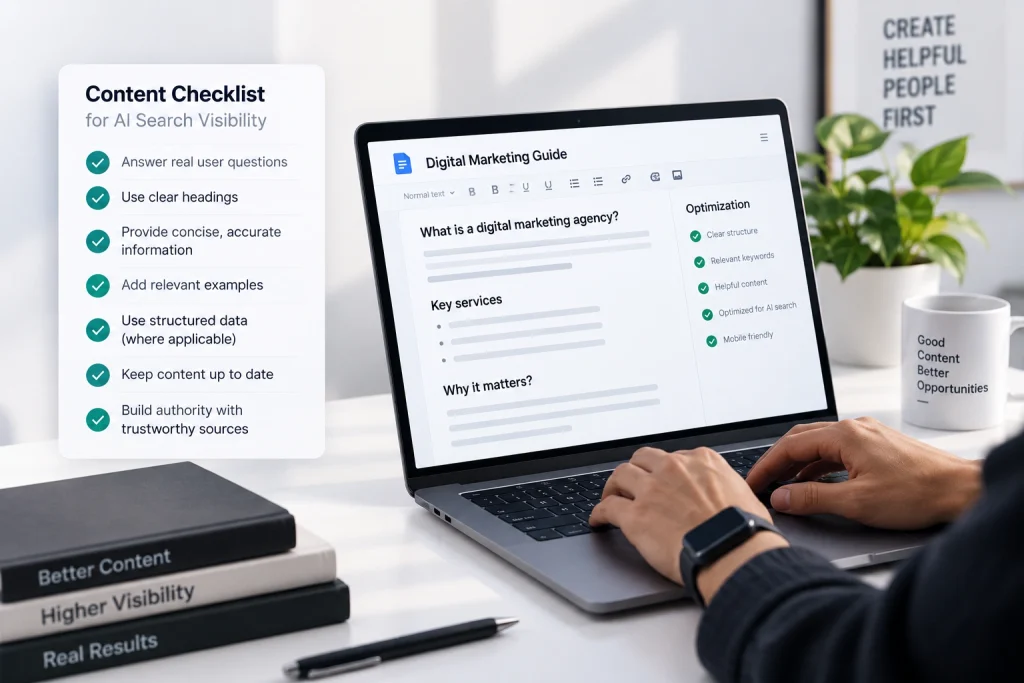
AEO encourages businesses to provide clear, concise, and well-structured answers.
Important AEO practices include:
- Creating question-based content
- Using clear headings and subheadings
- Providing direct answers
- Building FAQ sections
- Understanding search intent
- Organizing information logically
- Using relevant structured data where appropriate
In simple terms, SEO helps your content get discovered, while AEO helps make the answer within that content easier to identify and use.
What Is GEO?
GEO, or Generative Engine Optimization, is an emerging approach focused on improving how a brand, website, or its information may be discovered, understood, and represented by AI-powered search and generative answer systems.
Traditional search may provide a list of webpages. Generative search systems can instead synthesize information from multiple sources to produce a conversational response.
For example, a user might ask:
“What should a small business look for in a digital marketing agency?”
An AI-powered search experience may generate an answer using information gathered from multiple sources.
This makes factors such as brand authority, factual consistency, useful content, topical expertise, and relevant online mentions increasingly important.
GEO can involve:
- Building topical authority
- Publishing high-quality and original content
- Maintaining accurate business information
- Strengthening brand visibility across relevant platforms
- Creating content that directly addresses user needs
- Building credible third-party references and mentions
- Making website information clear and easy to understand
GEO is therefore not simply “SEO for AI.” It is about improving the overall digital presence and information ecosystem surrounding a brand.
SEO vs AEO vs GEO: What’s the Difference?
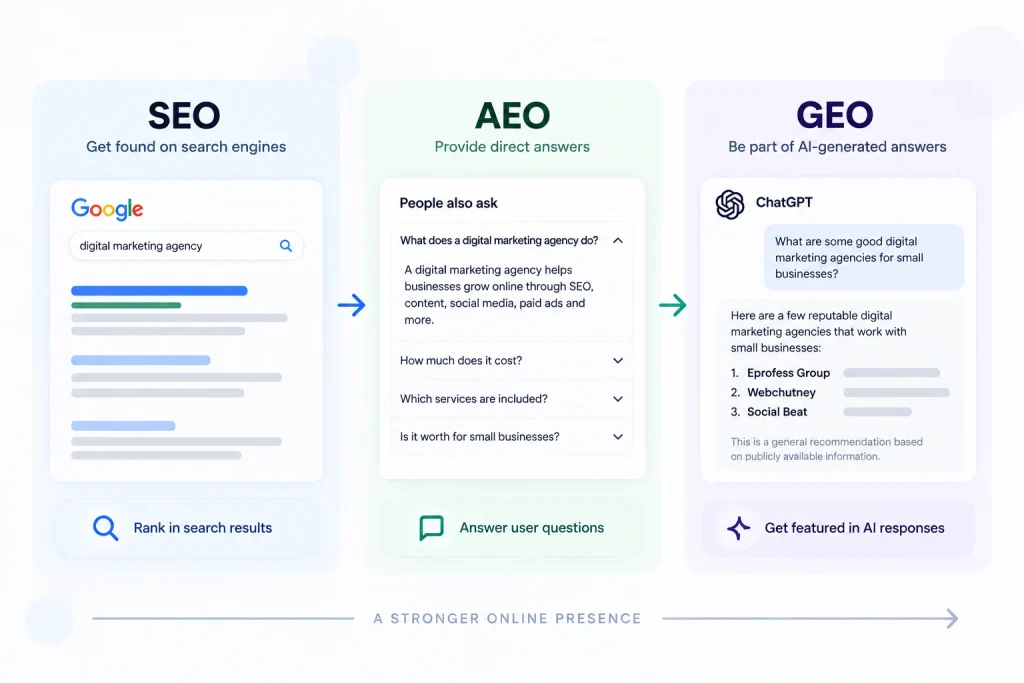
Although SEO, AEO, and GEO overlap, their primary focus is different.
| Strategy | Primary Focus | Main Objective |
|---|---|---|
| SEO | Search engines | Improve organic search visibility |
| AEO | Answer-driven search | Make useful answers easy to identify |
| GEO | Generative/AI search | Improve how brands and information are represented in AI-generated responses |
A simple way to understand the difference is:
SEO: Can people find your website?
AEO: Can search systems easily identify the answer your content provides?
GEO: Can AI-powered search systems understand your brand and relevant information about it?
These approaches shouldn’t be treated as replacements for one another.
They are increasingly interconnected parts of modern search visibility.
Why AEO and GEO Matter for Businesses
Search behaviour is moving beyond short keyword queries.
Users can now ask detailed, conversational questions such as:
“How can I generate more leads for my real estate business?”
“Which SEO strategy is suitable for a local business?”
“What should I include on my company’s website to improve conversions?”
These queries reveal more context and intent than a simple two- or three-word keyword.
For businesses, this creates an important opportunity.
Instead of creating content solely to rank for keywords, businesses can create resources that answer real customer questions and demonstrate genuine expertise.
This can help a business build visibility across multiple search experiences.
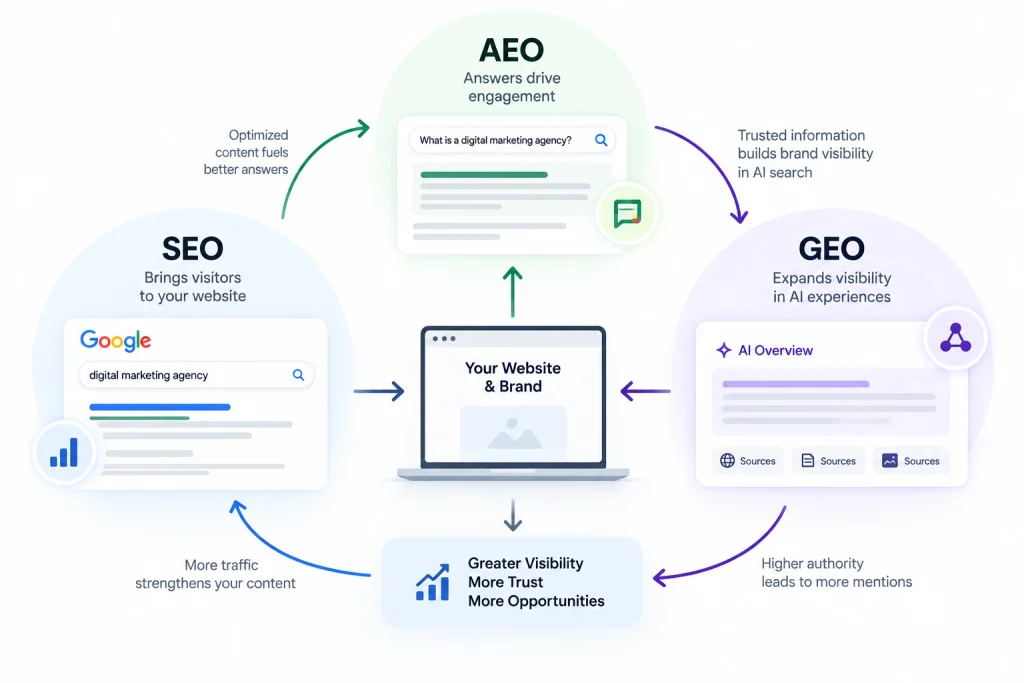
How SEO, AEO and GEO Work Together
The biggest mistake is thinking that businesses need three completely separate marketing strategies.
They don’t.
A strong SEO foundation can support both AEO and GEO.
SEO Builds the Foundation
Your website should have:
- A technically sound structure
- Fast and mobile-friendly pages
- Relevant content
- Clear navigation
- Internal links
- Search-intent-focused pages
- Strong topical coverage
AEO Makes Information Easier to Understand
Your content should:
- Answer specific questions
- Use descriptive headings
- Provide direct explanations
- Organize information logically
- Address common customer concerns
GEO Expands the Visibility Strategy
Your broader digital presence should focus on:
- Demonstrating expertise
- Building brand authority
- Maintaining consistent business information
- Publishing original and useful resources
- Earning relevant mentions and references
- Establishing a recognizable online presence
Together, these strategies create a more comprehensive approach to modern search visibility.
How Businesses Can Optimize for SEO, AEO and GEO
Businesses don’t need to completely rebuild their digital marketing strategy.
Instead, they can adapt their existing SEO and content efforts.
1. Create Content Around Real Customer Questions
Start by identifying the questions your target audience asks before making a purchase.
For example, a web development company could create content around:
- How much does a business website cost?
- How long does website development take?
- WordPress vs custom website: Which is better?
- What features should a business website have?
- How does website speed affect conversions?
This creates useful content that addresses genuine search intent.
2. Provide Clear Answers
When answering a specific question, don’t make users search through several paragraphs to find the answer.
Start with a concise explanation and then provide additional details.
For example:
What is Local SEO?
Local SEO is the process of optimizing a business’s online presence to improve its visibility for location-based searches.
The detailed explanation can follow underneath.
This structure improves readability while making important information easier for search systems to interpret.
3. Build Topical Authority
One article is rarely enough to establish strong expertise around a subject.
Businesses should create related content covering different aspects of the same topic and connect those pages through internal links.
For example, a digital marketing agency could build a content cluster around SEO:
SEO Basics → Keyword Research → Technical SEO → Local SEO → Content SEO → Link Building → SEO Analytics
This provides broader topical coverage and creates a stronger content ecosystem.
4. Keep Business Information Consistent
Businesses should maintain accurate and consistent information across their digital presence.
This can include:
- Business name
- Website
- Location
- Contact details
- Services
- Business descriptions
- Social profiles
Relevant information should be consistent across the website, business profiles, directories, social platforms, and other credible sources.
Consistency makes it easier for both users and search systems to understand a business.
5. Use Structured Data Where Appropriate
Structured data helps search engines understand specific information on a webpage.
Depending on the page, businesses may use relevant schema types such as:
- Organization
- LocalBusiness
- Article
- Product
- Service
- FAQ
Structured data does not guarantee higher rankings or inclusion in AI-generated answers, but it can provide additional machine-readable context about a webpage.
6. Prioritize Original and Useful Content
Publishing large amounts of generic content is not a substitute for expertise.
Businesses should focus on creating content that provides genuine value through:
- Original insights
- Case studies
- Data
- Examples
- First-hand experience
- Expert explanations
- Practical solutions
The objective should not be to publish the most content.
It should be to publish content worth finding, reading, and referencing.
Is SEO Still Important in the Age of AI?
Yes.
The growth of AI-powered search does not mean traditional SEO is dead.
Search engines still need to discover, understand, and evaluate information from websites and other online sources. Strong technical foundations, relevant content, good website architecture, and authoritative information remain important.
Instead of abandoning SEO, businesses should expand their approach.
Think of modern search visibility as:
SEO + AEO + GEO
SEO provides the foundation.
AEO helps businesses answer specific questions clearly.
GEO focuses on improving how a brand and its information can be understood and represented within generative search experiences.
The Future of Search Is About More Than Rankings
For years, businesses have measured search success primarily through keyword rankings.
Rankings still matter, but the customer journey is becoming more complex.
A potential customer might discover a business through:
Google Search → AI-generated answer → Google Maps → Social Media → Reviews → Website → Conversion
The path from search to purchase may involve multiple platforms.
This means businesses should focus not only on ranking individual pages but also on building a strong, trustworthy, and consistent digital presence.
Final Takeaway
AEO and GEO are not replacements for SEO.
They represent the evolution of how businesses need to think about search visibility as users increasingly interact with search engines, answer engines, and AI-powered platforms.
The businesses that adapt effectively should focus on a few fundamentals:
Build a technically strong website.
Create content that answers real customer questions.
Demonstrate genuine expertise.
Keep business information accurate and consistent.
Build authority across relevant digital platforms.
Focus on usefulness instead of simply producing more content.
The future of search isn’t just about getting your website to rank.
It’s about making your business, expertise, and information easy to discover, understand, and trust — wherever people search.
